Shopping abroad: 10 habits that keep more money in your pocket
- Written
- Read
- 3 min
- Words
- Tagio team
Most money lost abroad goes on invisible costs. Ten habits that keep it in your pocket.
Most of the money people lose abroad doesn't go on bad purchases. It goes on small, invisible costs: a poor exchange rate here, a fee there, and prices that only feel cheap because they are in another currency. These ten habits keep more of your money where it belongs.
1. Learn the rate before you land
Check the rate before you travel and pick one simple rule to remember, such as "add 10%" or "drop two zeros". Our guide to converting currency in your head has five tricks that work for most currencies.
2. Bring a card without foreign fees
Many cards charge a foreign transaction fee on every purchase abroad. A card that doesn't is one of the easiest savings you can make, especially on a long trip.
3. Always pay in the local currency
When a card machine offers to charge you in your own currency, say no. That option is dynamic currency conversion, and it usually costs more. Here's why.
4. Skip the airport exchange counter
Airport and tourist-area kiosks tend to offer the widest gap from the mid-market rate. If you need cash, a bank ATM is usually better value. Decline the ATM's conversion offer, too.
5. Know how prices are written
A decimal comma, a raised cent or a "/-" can make a price look very different from what it is. Our guide to reading price tags abroad covers the formats that catch people out.
6. Check whether tax is included
In the EU, the UK, Australia and Japan, the shelf price includes tax. In the US and Canada, sales tax is usually added at the till. Budget for it.
7. Compare per kilo, not per pack
Pack sizes differ between countries. The small unit price on the shelf label, per kilo or per litre, is the fairest way to compare products and spot real bargains.
8. Watch for "foreign money" thinking
Unfamiliar notes and big numbers can feel like play money. A habit that helps: before you buy anything, ask what it would cost at home. If you wouldn't pay that there, think twice here.
9. Ask about tax-free shopping
Many countries let visitors reclaim VAT or sales tax on larger purchases. Ask the shop if they offer tax-free forms, and keep your receipts until you leave the country.
10. Convert at the shelf, not at the till
The till is where pressure is highest: a queue, a card reader and a decision about currency. Know the price in your own money before you get there.
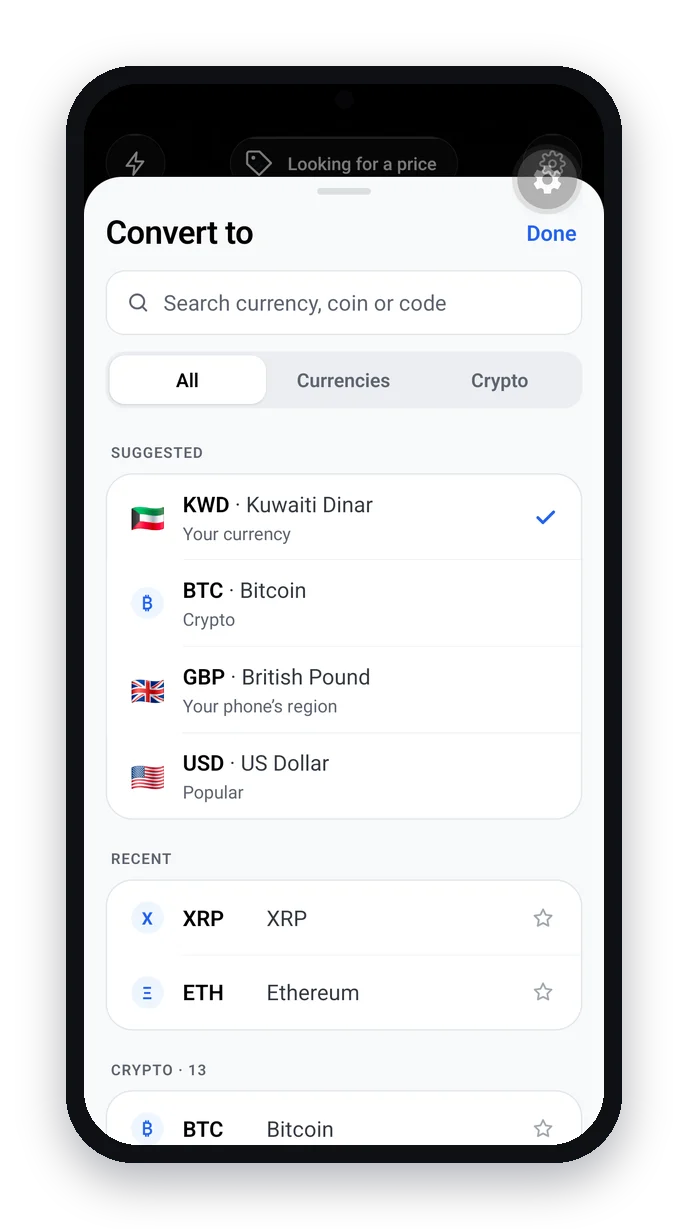
Tagio makes that effortless. Point your phone at a price tag and the price appears in your currency, with the age of the rate it used. It reads decimal commas, raised cents and currency codes, works offline with your last downloaded rates, and never stores what you scan.
Key points
- Most losses come from fees and rates, not purchases.
- Pay in local currency, with a card that has no foreign fees.
- Avoid airport kiosks; use bank ATMs and decline their conversion.
- Check tax, compare unit prices, and know the price in your money before the till.